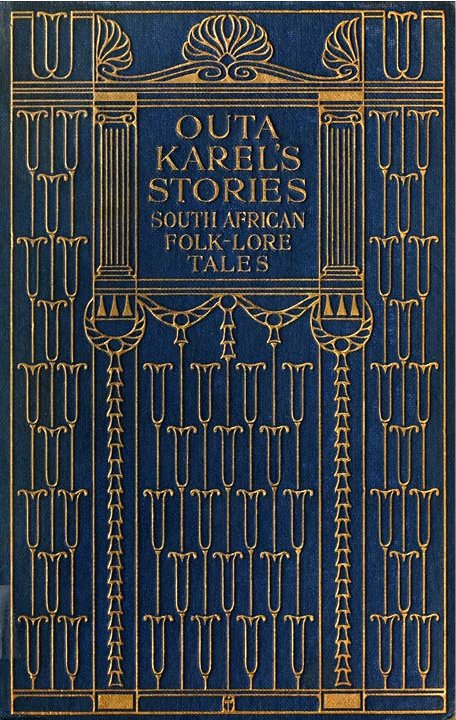
In South Africa we love the outdoors and camping and a very special time is sitting around the campfire in the evenings and telling stories. I recently came upon a book titled Outa Karel's Stories. Over the next few letters I will be featuring tales from this book which was published in 1914 and written by Sannie Metelerkamp. I will start off with the foreword and introduction before getting to the actual stories.
OUTA KAREL'S STORIES
SOUTH AFRICAN FOLK-LORE TALES BY SANNI METELERKAMP
MACMILLAN AND CO., LIMITED
ST. MARTIN'S STREET, LONDON
1914
FOREWORD.
MY thanks are due to Dr. Maitland Park,Editor of The Cape Times, and Adv.
B. K. Long, M.L.A., Editor of The State, for their kind permission to
republish such of these tales as have appeared in their papers.
For the leading idea in " The Sun " and "The Stars and the Stars' Road," I
gladly acknowledge my indebtedness to that monument of patient labour and
research,"
Specimens of Bushman Folk-lore," by the late Dr. Bleek and Miss Lucy
Lloyd. Further, I lay no claim to originality for
any of the stories in this collection at best a very small proportion of a
vast store from which the story-teller of the future may draw,embodying
the superstitions, the crude conceptions, the childish ideas of a
primitive and rapidly disappearing people. They are known in some form or
other wherever the negro has set foot, and are the common property of
every country child in South Africa.
I greatly regret that they appear here in what is, to them, a foreign
tongue. No one who has not heard them in the Taal that quaint, expressive
language of the people can have any idea of what they lose through
translation, but, having been written in the first instance for English
publications, the original medium was out of the question.
Clear cold evenings, with a pleasant tang of frost in the air, figure here
and there in these pages, but as I write other scenes, too, flit across
the lighted screen of Memorynoontides of tropic heat with all the world
sunk in a languorous slumber, glowing sunsets, throbbing summer nights
when the stars seemed to tremble almost within one's reach, moonlit spaces
filled with soft mystery and the thousand seductive voices of the pulsing
southern night. And always, part and parcel of the passing panorama, the
quaint figure of the old Native with his little masters.
It is nearly three years now since "Old Friend Death " took him gently by
the hand and led him away to that far, far country of which he had such
vague ideas, so he tells no more stories by the firelight in the gloaming
; and his little masters children no longer are claimed by graver tasks
and wider interests. But in the hope that others, both little ones and
children of a larger growth, may find the same pleasure in these tales of
a childlike race, they are sent out to find their own level and take their
chance in the workaday world.
S. M.
CAPE TOWN, January, 1914.
THE PLACE AND THE PEOPLE.
IT was winter in the Great Karroo. The evening air was so crisp and
cutting that one seemed to hear the crick-crack of the
frost, as it formed on the scant vegetation.
A skraalwindje blew from the distant mountains, bringing with it a mingled
odour of karroo-bush, sheep-kraals, and smoke from the Kafir huts none,
perhaps, desirable in itself, but all so blent and purified in that rare,
clear atmosphere, and so subservient to the exhilarating freshness, that
Pietie van der Merwe took several sniffs of pleasure as he peered into the
pale moonlight over the lower half of the divided door. Then, with a
little involuntary shiver, he closed the upper portion and turned to the
ruddy warmth of the purring fire, which Willem was feeding with mealie-cobs
from the basket beside him.
Little Jan sat in the corner of the wide, old-fashionedrustbank, his large
grey eyes gazing wistfully into the red heart of the fire, while his hand
absently stroked Torry, the fox terrier, curled up beside him.
Mother, in her big Madeira chair at the side table, yawned a little over
her book ; for, winter or summer, the mistress of a
karroo farm leads a busy life, and the end of the day finds her ready for
a well-earned rest.
Pietie held his hands towards the blaze, turning his head now and again
towards the door at the far end of the room. Presently this opened and
father appeared, comfortably and leisurely, as if such things as shearing,
dipping, and ploughing were no part of his day's work. Only the healthy
tan, the broad shoulders, the whole well-developed physique proclaimed his
strenuous, open-air life. His eye rested with pleasure on the scene before
him the bright fire, throwing gleam and
shadow on painted wall and polished woodwork, and giving a general air of
cosiness to everything ; the table spread for the evening meal ; the group
at the fireside ; and his dear helpmate who was responsible for the
comfort and happiness of his well-appointed home.
He was followed in a moment by Cousin Minnie, the bright-faced young
governess.
Their coming caused a stir among the children. Little Jan slowly withdrew
his gaze from the fire, and, with more energy
than might have been expected from his dreamy look, pushed and prodded the
sleeping terrier along the rustbank so as to make room for Cousin Minnie.
Pietie sprang to his father's side.
" Now may I go and call Outa Karel ?" he asked eagerly, and at an
acquiescent "Yes, my boy," away he sped.
It was a strange figure that came at his bidding, shuffling, stooping,
halting, and finally emerging into the firelight. A stranger might have
been forgiven for fleeing in terror, for the new arrival looked like
nothing so much as an ancient and muscular gorilla in man's clothes, and
walking uncertainly on its hind legs.
He was not quite four feet in height, with shoulders and hips
disproportionately broad, and long arms, the hands of which reached midway
between knee and ankle. His lower limbs were clothed in nondescript
garments fashioned from wildcat and dassie skins ; a faded brown coat,
which from its size had evidently once belonged to his master, hung nearly
to his knees ; while, when he removed his shapeless felt hat, a red
kopdoek was seen to be wound tightly round his head.
No one had ever seen Outa Karel without his kopdoek, but it was reported
that the head it covered was as smooth and devoid of hair as an ostrich
egg.
His yellow-brown face was a network of wrinkles, across which his flat
nose sprawled broadly between high cheekbones ; his eyes, sunk far back
into his head, glittered dark and beady like the little wicked eyes of a
snake peeping from the shadow of a hole in the rocks. His wide mouth
twisted itself into an engaging grin, which extended from ear to ear, as,
winking and blinking his bright little eyes, he twirled his old hat in his
claw-like hands and tried to make obeisance to his master and mistress.
The attempt was unsuccessful on account of the stiffness of his joints,
but it never failed to amuse those who, times without number, had seen it
repeated. To those who witnessed it for the first time it was something to
be remembered the grotesque, disproportionate form ; the ape-like face,
that yet was so curiously human ; the humour and kindness that gleamed
from the cavernous eyes, which seemed designed to express only malevolence
and cunning ; the long waving
arms and crooked fingers ; the yellow skin for all the world like a
crumpled sheet of india-rubber pulled in a dozen different
directions.
That he was a consummate actor, and, not to put too fine a point on it, an
old humbug of the first water, goes without saying, for these
characteristics are inherent in the native nature. But in spite of this,
and the uncanniness of his appearance, there was something about Outa
Karel that drew one to him. Of his real devotion to his master and the
"beautiful family Van der Merwe," there could be no question ; while,
above everything, was the feeling that here was one
of an outcast race, one of the few of the original inhabitants who had
survived the submerging tide of civilization ; who, knowing no law but
that of possession, had been scared and chased from their happy hunting
grounds, first by the Hottentots, then by the powerful Bantu, and later by
the still more terrifying palefaced tribes from over the seas. Though
the origin of the Bushman is lost in the mists of antiquity, the Hottentot
conquest of him is a matter of history, and it is well known that the
victors were in the habit, while killing off the men, to take unto
themselves wives from among the women of the vanquished race. Hence
the fact that a perfect specimen of a Bushman is a raraavis, even in the
localities where the last remnants are known to linger.
Outa Karel could hardly be called a perfect specimen of the original race,
for, though he always spoke of himself as wholly Bushman, there was a
strong strain of the Hottentot about him, chiefly noticeable in his build.
He spoke in Dutch, in the curiously expressive voice belonging to these
people, just now honey-sweet with the deference he felt for his superiors.
"Ach toch!Night, Baas. Night, Nooi.Night, Nonnie and my little baasjes.
Excuse that this old Bushman does not bend to greet you ; the will is
there, but his knees are too stiff. Thank you, thank you, my baasje," as
Pietie dragged a low stool, covered with springbok skin, from under the
desk in the recess and pushed it towards him. He settled himself on it
slowly and carefully, with much creaking of joints and many strange native
ejaculations.
The little group had arranged itself anew.
Cousin Minnie was in the cosy corner of the rustbank near the wall, little
Jan next her with his head against her, and Torry's head on his lap this
attention to make up for his late seeming unkindness in pushing him away.
Pappa, with his magazine, was at the other end of the rustbank where he
could, if he chose, speak to Mamma in a low tone, or peep over to see how
her book was getting on. Willem had pushed the basket away so as to settle
himself more comfortably against Cousin Minnie's knee as he sat on the
floor, and Pietie was on a small chair just in front
of the fire.
The centre of attention was the quaint old native, who, having relegated
his duties to his children and grandchildren, lived as a privileged
pensioner in the van der Merwe family he had served so faithfully for
three generations. The firelight played over his quaint figure with the
weirdest effect, lighting up now one portion of it, now another, showing
up his astonishingly small hands and crooked fingers, as he pointed and
gesticulated incessantly for these people speak as much by gesture as by
sound and throwing exaggerated shadows on the wall.
This was the hour beloved by the children, when the short wintry day had
ended, and,in the interval between the coming of darkness and the evening
meal, their dear Outa Karel was allowed in to tell them stories.
And weird and wonderful stories they were tales of spooks and giants, of
good and bad spirits, of animals that talked, of birds, beasts and insects
that exercised marvellous influence over the destinies of unsuspecting
mankind.
But most thrilling of all, perhaps, were Outa Karel's personal experiences
adventures by veld and krantz with lion, tiger, jackal and crocodile, such
as no longer fall to the lot of mortal man.
The children would listen, wide-eyed and breathless, and even their
elders, sparing a moment's attention from book or writing, would feel a
tremor of excitement, unable to determine where reality ended and fiction
began, so inextricably were they intermingled as this old lago of the
desert wove his romances.
" Now, Outa, tell us a nice story, the nicest you know," said little Jan,
nestling closer to Cousin Minnie, and issuing his command as the autocrat
of the " One Thousand and One Nights" might have done.
" Ach ! but klein baas, this stupid old black one knows no new stories,
only the old ones of Jakhals and Leeuw, and how can he tell
even those when his throat is dry ach, so dry with the dust from the
kraals ?"
He forced a gurgling cough, and his small eyes glittered expectantly. Then
suddenly he started with well-feigned surprise and beamed on Pietie, who
stood beside him with a soopje in the glass kept for his especial use.
This was a nightly performance. The lubrication was never forgotten, but
it was often purposely delayed in order to see what
pretext Outa would use to call attention to the fact of its not having
been offered. Sore throat, headache, stomach-ache, cold, heat, rheumatism,
old age, a birthday (invented for the occasion), the killing of a snake or
the breaking-in of a young horse anything served as an excuse for what was
a timehonoured custom.
" Thank you, thank you, mijkleinkoning. Gezondheid to Baas, Nooi, Nonnie,
and the beautiful family van der Merwe." He lifted the glass, gulped down
the contents, and smacked his lips approvingly.
" Ach ! if a Bushman only had a neck like an ostrich ! How good would the
soopje taste all the way down ! Now I am strong again ; now I am ready to
tell the story of Jakhals and Oom Leeuw."
" About Oom Leeuw carrying Jakhals on his back ? " asked Willem.
"No, baasje. This is quite a different one."
And with many strange gesticulations, imitating every action and changing
his voice to suit the various characters, the old
man began :
To be continued…..
